


As the scheduling season commences, students are preparing to outline their academic goals for the upcoming school year. Although the general scheduling process has remained largely consistent—with minor exceptions, according to Social Studies teacher Mr. Nathaniel Langelli—updates to counseling assignments and expanded class offerings are going to alter students’ plans.
Two relatively new counselors, third-year Ms. Hope Bennet and first-year Mr. Philip Goerig, is tasked with leading the scheduling process. Students are assigned to either counselor alphabetically by last name—Bennet works with students A through L, and Goerig serves M through Z. Unlike previous years, students now work with the same counselor throughout high school.
“The counselors are individuals that play the most significant role in the process,” High School Principal Mr. Steven Mott said. “[They will be] making sure that each student is taking classes that will help them with their future goals, while also meeting our graduation requirements.”
Preparation for the scheduling process started earlier this month, when the sophomore class met with a representative from the Beaver County Career and Technology Center (BCCTC). The representative introduced students to vocational and technical programs, and provided them with an opportunity to sign up for a tour of their programs of interest at BCCTC.
“One of the most important things we can do is create opportunities for our students to grow, and ultimately find their passion for when they leave,” Mott said.
Administrators are currently updating the program of studies to reflect next year’s course offerings. Within the next few months, Bennet and Goerig will meet with students by grade level during PLT to distribute course request forms listing all available classes. Juniors will be the first to meet with counselors.
Request forms must be approved by a parent or guardian before submission. According to Mott, this is required to ensure families are included in the final decision.
Counselors will meet with students individually to review class selections and to address potential conflicts in the schedule. These meetings are designed to determine how a student can meet graduation requirements while taking classes that suit their long-term goals. After all requests are submitted, student demand shapes the master schedule,
Elective classes may be added to the master schedule to meet high-demand or specific needs. Some of the elective classes have become graduation requirements. For instance, the high school launched a Personal Finance class after parents and students mentioned wanting to learn valuable life skills, such as budgeting, safe spending and financial planning. Simultaneously, the Pennsylvania legislature mandated financial literacy instruction. Ms. Michelle Sterrett has taught this class, in addition to High School Exploration, for three years.
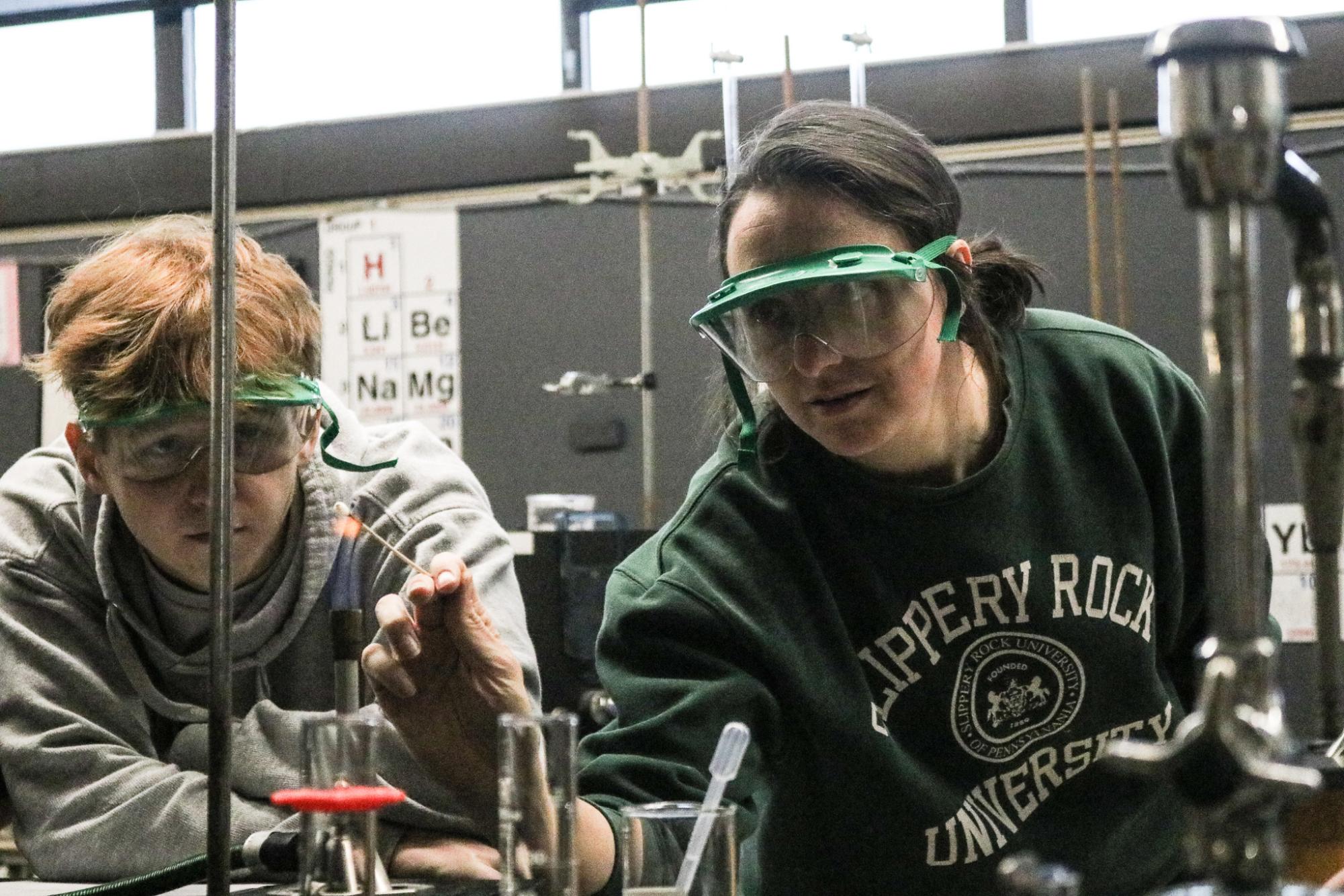
By autumn, the high school aims to expand its College in High School (CHS) opportunities in collaboration with the Community College of Beaver County (CCBC). Two new classes are going to be added to the roster: Advanced Placement (AP) and CHS Chemistry as well as AP and CHS Calculus. Currently, Chemistry is offered as a CHS course through the University of Pittsburgh, and AP Calculus is taught by Mr. Ed Majors.
CHS Chemistry, taught by Ms. Debrah Evans, will transfer partnership to CCBC to provide additional content in the second semester that is not covered in the current curriculum. In the fall, AP Calculus will become CHS Calculus. The changes will offer students the AP stringency with the benefit of earning college credit.
After the additions are factored into the program of studies, the high school will offer a total of 12 CHS courses: English Composition and Concepts in Literature, taught by Mr. Kenneth Dickey; American Literature and Public Speaking, taught by Mr. Aaron Fitzpatrick, Western Civilizations I, II and U.S. History I, II, taught by Langelli; Chemistry; Psychology, taught by Ms. Maria Porter; Calculus and Biology. Of these, four are yearlong classes, while the others alternate each semester.
“I’m proud of all of the course offerings we provide at Freedom. For a small school we offer a wide array of classes,” Mott said.
When teachers propose a new class, they present the idea for approval. If there’s enough interest in the subject, a course description is typed and sent to the school board. Then it is added to the program of studies.
Langelli has developed electives, such as Conflicts and Conspiracies, True Crime and Secret Societies and Scandals over the years he has taught at the high school. He sets these classes on a rotating schedule. One year, for instance, he offers True Crime, then the following year he teaches Secret Societies and Scandals. He said that rotating them allowed students to take two classes they like over two years, instead of being forced to pick between them.
“Ultimately, it’s about engaging with student interest,” Langelli said. “But it’s also giving them the most opportunities to explore new topics that they might not otherwise get the opportunity to.”
According to the administration, the ultimate goal is to surpass academic standards and help students discover passions to prepare for post graduation.
“Our teachers work incredibly hard to create interesting courses that are meant to peak our students’ interests, while keeping them engaged,” Mott said. “Offering a wide variety of courses allows us to do that.”